




Maintaining a precise suspension configuration is vital for protecting your truck investment, ensuring highway safety, and preserving tire longevity. Heavy-duty work cycles, daily commuting, and navigating local roadways can slowly knock your steering geometry out of its factory-specified parameters. When your front or rear wheels point in conflicting directions, the tires slide across the asphalt rather than rolling smoothly, accelerating tread wear and forcing your engine to work harder.
For commercial drivers hauling heavy payloads or families utilizing their trucks for weekend recreation, an unaligned steering system compromises handling when you need it most. Misalignment directly impacts how your truck tracks on the highway, often causing the vehicle to pull to one side or requiring constant steering corrections. Over time, this struggle increases driver fatigue and places unnecessary mechanical stress on your steering linkage, ball joints, and control arm bushings.
If you suspect your truck is pulling or showing signs of uneven tire wear, bringing it to a specialized facility is the best course of action. You can easily find our service center by getting directions to our Dartmouth location to have our factory-trained technicians inspect your suspension. If you prefer to speak with a service advisor first to discuss your truck's handling symptoms, feel free to give us a quick call to get professional guidance.
Table of Contents
- How Often Should You Align the Wheels on a Ram Truck?
- Can a Bad Wheel Alignment Cause Vibrations in a Ram 1500?
- Is a Four-Wheel Alignment More Expensive Than a Two-Wheel Alignment?
- Can You Align a Lifted Ram Truck Back to Factory Specifications?
- What Is a Steering Angle Sensor Reset and Why Does Your Ram Need It?"
- Common Questions About Ram Suspension and Steering Maintenance
- Schedule Certified Mopar Wheel Alignment Services in Dartmouth
How Often Should You Align the Wheels on a Ram Truck?
Determining the ideal interval for checking your truck's alignment depends heavily on your driving habits, road conditions, and how you use your vehicle. As a general industry standard, a professional alignment check is recommended every 6,000 to 12,000 miles, which conveniently aligns with every other oil change or tire rotation interval. However, trucks subjected to demanding work environments, regular towing, or frequent travel over rough terrain may require more frequent inspections to maintain optimal driving dynamics.
Certain driving events should serve as immediate triggers for an unscheduled alignment check. If you strike a deep pothole, slide against a curb, or notice your steering wheel is off-center while driving straight, your suspension geometry has likely shifted. Furthermore, performing an alignment is mandatory whenever you install a new set of tires or replace vital steering components like tie rods, ball joints, or control arms. Skipping this step with new tires can ruin your investment in a matter of weeks by creating rapid, irregular tread wear patterns.
When suspension components wear out, replacing them with high-quality components is essential to ensure the alignment holds over time. Our parts department stocks a comprehensive inventory of genuine Mopar steering and suspension parts designed specifically to match the engineering tolerances of your truck. Utilizing original equipment manufacturer parts ensures that once your vehicle is aligned, it remains within factory specifications under heavy loads.
Can a Bad Wheel Alignment Cause Vibrations in a Ram 1500?
A common misconception among truck owners is that a steering wheel shake or chassis vibration is directly caused by a bad wheel alignment. In the vast majority of cases, misalignment on its own does not produce a physical vibration. Instead, a misaligned front end typically manifests as a distinct pull to one side, an off-center steering wheel, or rapid, uneven tire wear.
When you feel a distinct vibration in your 2026 RAM 1500, the culprit is almost always a rotating component that is out of balance or physically damaged. Out-of-balance tires, bent wheels, unevenly worn tire tread, or a failing driveshaft are the primary sources of highway-speed vibrations. However, there is a secondary connection: if your truck remains misaligned for an extended period, it will cause irregular tire wear patterns like cupping or feathering, and those physical tread deformities will eventually produce a noticeable ride vibration.
If you experience a vibration through the steering wheel or seat, our technicians will perform a comprehensive diagnostic process. We inspect the tire balance, check for bent wheels, and evaluate the condition of your suspension bushings and wheel bearings. Once we isolate and resolve the source of the vibration, we perform a precision alignment to ensure your tires roll straight and wear evenly moving forward.
Is a Four-Wheel Alignment More Expensive Than a Two-Wheel Alignment?
Understanding the mechanical differences between alignment types helps clarify why service costs vary. A two-wheel alignment, often referred to as a front-end alignment, only measures and adjusts the steering angles on the front axle. A four-wheel alignment is a more comprehensive procedure where technicians measure and adjust all four wheels to ensure they are perfectly parallel to each other and perpendicular to the road.
Because a four-wheel alignment requires setting both the front and rear suspension angles, it involves more labor, specialized diagnostic equipment, and time, making it more expensive than a basic two-wheel service. However, for modern vehicles, a four-wheel alignment is the only way to guarantee the truck tracks perfectly straight. Even on trucks with a solid rear axle, a four-wheel alignment is highly beneficial because it allows technicians to measure the rear thrust angle and adjust the front wheels to match the tracking path of the rear wheels.
Investing in a complete four-wheel alignment ultimately saves you money over the lifespan of your vehicle. Correcting the alignment on both axles minimizes rolling resistance, which directly optimizes your fuel economy and prevents premature tire replacement. For local drivers commuting from Providence, where urban stop-and-go driving and varying road surfaces place constant stress on steering systems, keeping all four wheels properly aligned is key to maintaining a smooth, predictable ride.
Can You Align a Lifted Ram Truck Back to Factory Specifications?
Modifying your truck's ride height with a suspension lift kit completely alters the steering geometry, changing the angles of your control arms, driveshafts, and steering linkage. When a truck is lifted, the caster and camber angles are often pushed far outside of their original design parameters. Attempting to align a modified truck back to original factory specifications presents unique mechanical challenges that standard alignment procedures cannot always resolve.
Depending on the height of your lift kit, returning to original caster or camber settings may be physically impossible using only the factory adjustment slots. To achieve a proper alignment on a lifted truck, you often need to install aftermarket adjustable control arms, correction brackets, or adjustable ball joints to restore the necessary range of movement. Without these supporting modifications, a lifted truck may suffer from flighty steering, poor self-centering behavior, or accelerated tire wear.
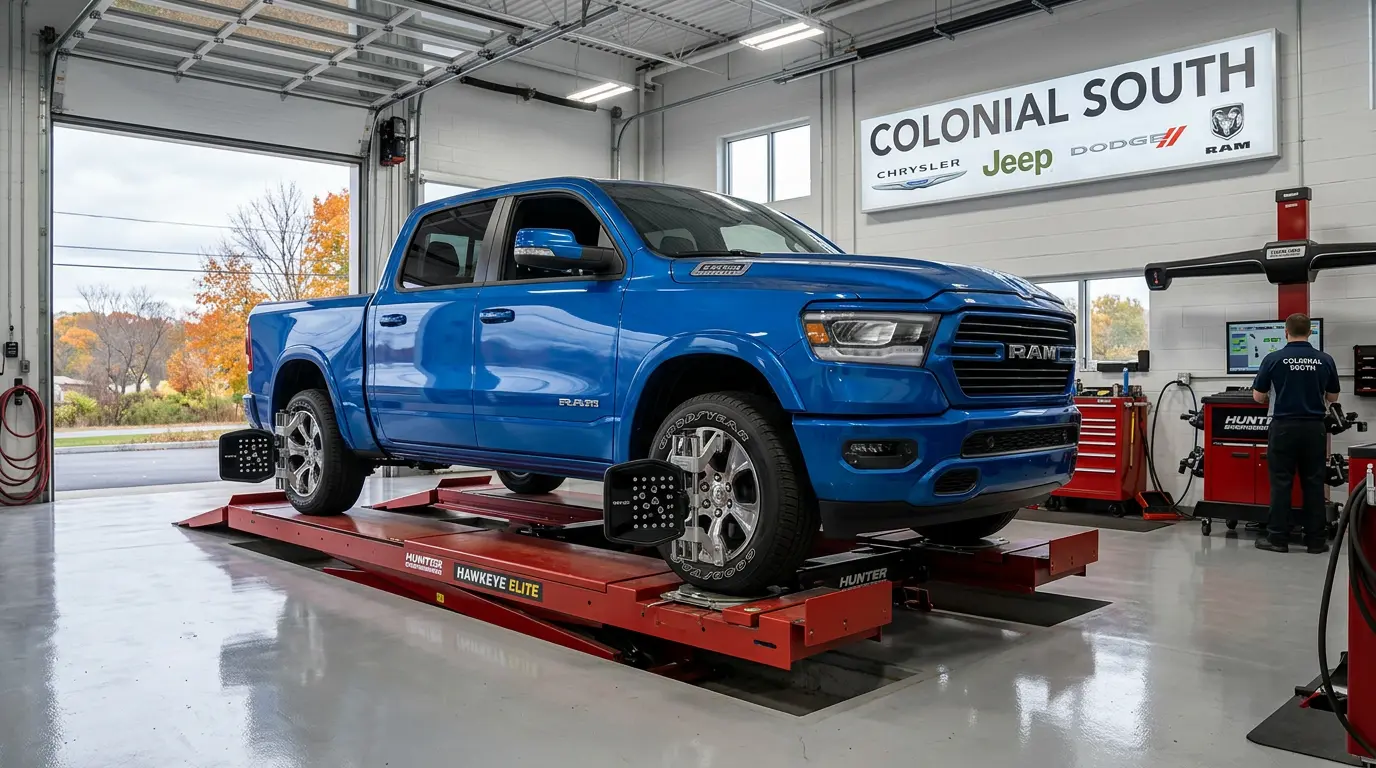
Our service department utilizes advanced alignment racks capable of measuring modified suspensions and adjusting them to custom specifications that maximize drivability. We understand how aftermarket lifts interact with the steering geometry and can recommend the exact hardware adjustments needed to keep your modified truck driving straight and handling predictably on the highway.
What Is a Steering Angle Sensor Reset and Why Does Your Ram Need It?"
Modern trucks rely on a sophisticated network of electronic driver-assist systems to maintain stability, traction, and safety. At the heart of these systems is the Steering Angle Sensor, a digital device that measures the physical angle of your steering wheel and reports it to the vehicle's onboard computer. This data is critical for the proper operation of electronic stability control, adaptive cruise control, and lane-keep assist technologies.
When a technician performs a wheel alignment, they physically adjust the steering linkage to center the wheels, which often changes the relationship between the physical steering wheel position and the sensor's digital zero-point. A Steering Angle Sensor reset is an electronic calibration process performed with a diagnostic scan tool that tells the vehicle's computer exactly what "straight ahead" looks like after physical adjustments have been made.
If this electronic reset is skipped, your truck's safety systems may believe the vehicle is sliding or turning when it is actually traveling straight down the highway. This mismatch can trigger warning lights on your dashboard, disable your traction control, or cause the stability control system to apply the brakes unexpectedly. Our certified technicians perform this electronic calibration as a standard part of our alignment process to ensure all safety systems function flawlessly.
Common Questions About Ram Suspension and Steering Maintenance
When it comes to maintaining your truck's steering and suspension, having clear answers to common service questions can help you make informed decisions about your vehicle's care.
How do I know if my truck has active air suspension?
If your truck is equipped with an active air suspension system, you will notice ride-height adjustment buttons on your center console, and the vehicle will automatically lower at highway speeds to improve aerodynamics. Before performing an alignment, our technicians use diagnostic tools to lock this suspension into a dedicated alignment mode, ensuring the ride height remains completely static and accurate during the measurement process.
Will a bad alignment affect my truck's towing capability?
Yes, a misaligned suspension can severely impact your towing stability and safety. When hauling a heavy trailer, any existing alignment issues are amplified, which can lead to trailer sway, poor steering feedback, and accelerated wear on your rear tires. Ensuring your truck is properly aligned before towing a heavy load is crucial for maintaining control and safety on the road.
What should I do if my steering wheel is crooked but the truck drives straight?
A crooked steering wheel is a primary indicator of an off-center alignment, meaning the front toe angles are unevenly adjusted. Even if the vehicle does not pull to one side, driving with an off-center wheel can confuse your steering angle sensor and disable your electronic stability systems. We highly recommend scheduling an inspection to have our team reset your steering geometry.
If you are experiencing any of these symptoms or have questions about your truck's suspension health, we encourage you to schedule a service appointment online with our certified technicians.
Schedule Certified Mopar Wheel Alignment Services in Dartmouth
Maintaining the precise alignment of your truck is essential for preserving tire life, maximizing fuel efficiency, and ensuring a safe, comfortable ride. At Colonial South Chrysler Ram Jeep and Dodge, our state-of-the-art service facility is fully equipped with advanced diagnostic alignment systems and staffed by factory-certified Mopar technicians who understand the intricate suspension setups of light-duty and heavy-duty trucks alike. Whether you drive a standard passenger vehicle or a heavily modified work truck, we have the specialized tools and expertise required to restore your steering geometry to its exact specifications.
Before booking your next appointment, we invite you to explore our current service and parts specials to take advantage of valuable maintenance offers. When you are ready to visit us, our service center is conveniently located at 42 State Rd, Dartmouth, MA 02747, making it an easy drive for truck owners throughout the surrounding areas. To find the quickest route to our department, you can view our location and get detailed driving directions online. If you have any immediate questions about our alignment procedures, equipment capabilities, or scheduling availability, please give our service team a direct call to speak with an advisor.
© 2026 Colonial South Chrysler Ram Jeep and Dodge. All rights reserved.