



You know your Ram 1500 needs exhaust repair if you hear a sharp ticking or tapping noise from the engine bay on cold starts, feel a metallic vibration or droning under acceleration, notice a drop in fuel efficiency, smell exhaust fumes near the cab, or see an illuminated check engine light on your instrument cluster. These warning signs indicate gas escaping through broken manifold hardware, cracked piping, or a degraded exhaust gasket.
A vehicle exhaust system is designed to route high-temperature gases safely away from the passenger compartment, suppress combustion noise, and maintain proper engine backpressure. When any component along the exhaust path degrades, engine performance and cabin air quality drop quickly. Early detection prevents minor exhaust leaks from scorching nearby wiring harnesses, warping adjacent components, or damaging oxygen sensors.
Primary warning signs that indicate your Ram truck requires professional exhaust attention include:
- A rhythmic ticking sound near the engine compartment that softens or disappears once the engine reaches normal operating temperature
- Loud rumbling, sputtering, or metallic rattling coming from underneath the vehicle body
- The odor of exhaust emissions or unburned fuel inside or around the truck cab
- Reduced throttle response and decreased gas mileage caused by skewed air-fuel readings
- A steady or flashing check engine light triggered by emissions-system diagnostic codes
If your truck exhibits any of these symptoms, visiting our team at Colonial South Chrysler Ram Jeep and Dodge ensures an accurate diagnosis using factory diagnostic tools. You can drop by finding our Dartmouth service center at 42 State Rd, Dartmouth, MA 02747 or reach out directly by calling (508) 984-1900 to consult with our service advisors.
Table of Contents
- What Type of Exhaust System Does the 2027 Ram 1500 Use?
- What Are the Symptoms and Costs of Ram Exhaust Manifold Bolt Repair?
- What Is the Difference Between Stainless Steel and Aluminized Steel Exhaust Systems?
- Will an Aftermarket Exhaust System Pass Massachusetts Emissions Testing?
- How Long Does a Typical Ram Muffler Replacement Take?
- Where Can You Get Ram Exhaust System and Muffler Repairs Near Dartmouth and Fall River?
- Common Questions About Ram Exhaust and Muffler Service
- Keep Your Ram Truck Running Quiet and Efficiently
What Type of Exhaust System Does the 2027 Ram 1500 Use?
The 2027 Ram 1500 in Dartmouth uses a factory-engineered stainless steel exhaust system engineered in single or dual rear-exit configurations, featuring integrated resonators and active tuning valves designed to balance exhaust flow with acoustic control. This system connects directly to the engine exhaust manifolds, routing gases through catalytic converters, crossover pipes, and acoustic dampeners engineered specifically for each powertrain option.
Ram equips the 1500 lineup with engine-specific exhaust layouts. Models powered by the 3.6L Pentastar V6 utilize a high-flow single or available dual exhaust path tuned for smooth engine breathing. Configuration options featuring the 3.0L Hurricane twin-turbo inline-six engine utilize precision-cast manifolds and short-run downpipes designed to maximize turbocharger spooling while maintaining optimal thermal efficiency. Off-road and special-edition trims, such as the Rebel or Backcountry, feature elevated exhaust clearance and protective heat shielding over transfer case lines.
Key engineering components within the Ram 1500 exhaust assembly include:
- Double-walled exhaust manifolds or turbo downpipes rated for extreme thermal expansion cycles
- High-efficiency catalytic converters fitted with dual upstream and downstream oxygen sensors
- Active exhaust valves that open under heavy throttle to reduce backpressure during towing or hauling
- Acoustic resonators and multi-chamber mufflers tuned to eliminate low-frequency cabin drone
- Stainless steel tailpipes equipped with integrated dual chrome or black-coated tips on select trim levels
Because factory exhaust systems rely on electronic valves and fine-tuned backpressure, replacing pipes or mufflers with generic parts can alter engine tuning. Factory-trained technicians ensure every replacement component aligns with original equipment specifications to maintain power output and sound quality.
What Are the Symptoms and Costs of Ram Exhaust Manifold Bolt Repair?
Ram exhaust manifold bolt repair addresses broken fastener studs and warped manifold flanges, which manifest as a loud metallic ticking noise on cold startups, burning smells, and check engine lights for lean fuel conditions. Total repair costs typically range from $600 to $1,200 per engine bank, depending on whether stud extraction requires specialized cylinder-head drilling or if the exhaust manifold itself requires replacement.
When truck owners bring in a Ram V8 with a ticking sound on cold starts, our technicians often check the rear exhaust manifold bolts first, as high thermal cycles can stretch or snap those factory fasteners. The steel bolts expand and contract at a different rate than the aluminum cylinder heads, causing the rear studs on the manifold to shear off over time. Once a stud snaps, exhaust gas blows past the manifold gasket, creating an audible exhaust leak that erodes the gasket material.
The step-by-step process for resolving manifold bolt failure involves several precise service procedures:
- Performing a smoke test or physical inspection to identify the exact location of snapped studs and gasket erosion
- Removing inner fender liners, heat shields, and steering shaft clearances to gain direct access to the exhaust manifold
- Unbolting the exhaust manifold and extracting broken stud shanks from the cylinder head using extraction tools
- Inspecting the manifold surface for warping using a precision straightedge, replacing warped castings with new components
- Installing heavy-duty multi-layer steel gaskets and hardened replacement studs torqued strictly to factory torque settings
Ignoring broken manifold bolts allows hot exhaust gases to blast against nearby valve covers, brake lines, and wiring looms, turning a straightforward bolt repair into a major electrical or engine fix. Drivers experiencing cold-start engine noise can protect their powertrain by scheduling an exhaust service appointment with our certified technicians before minor leaks cause severe component damage.
What Is the Difference Between Stainless Steel and Aluminized Steel Exhaust Systems?
The primary difference between stainless steel and aluminized steel exhaust systems is chemical corrosion resistance: stainless steel utilizes chromium or nickel alloys to withstand moisture and road salt indefinitely, whereas aluminized steel relies on a thin aluminum coating over carbon steel that degrades rapidly once exposed to road debris and winter chemicals.
In coastal and cold-weather regions, exhaust hardware faces continuous exposure to harsh road salts and ambient humidity. Vehicles driven near Narragansett Bay in Providence routinely encounter saltwater mist and chemical ice-melters that quickly penetrate thin surface coatings. On an aluminized steel pipe, a single stone chip or gravel scrape exposes the underlying raw steel, triggering rapid oxidation, flaking, and pinpoint exhaust leaks within two to three winters.
| Feature / Metric | Stainless Steel (304 / 409 Grade) | Aluminized Steel |
|---|---|---|
| Base Material | Iron alloyed with chromium & nickel | Carbon steel dipped in aluminum alloy |
| Corrosion Resistance | Exceptional resistance to salt & rust | Moderate in dry climates; low in salt zones |
| Expected Lifespan | 8 to 15+ years under severe duty | 3 to 5 years in winter road-salt conditions |
| Thermal Tolerance | Maintains structural integrity under high heat | Coating can burn off near manifold temperatures |
| Impact Resilience | Resists scaling when struck by road debris | Flakes easily when stone-chipped or scraped |
Ram fits its trucks with factory stainless steel exhaust tubing, ensuring long-term structural integrity for structural hangars, muffler shells, and tailpipe sections. When replacing damaged mid-pipes or tailpipe assemblies, choosing genuine stainless steel prevents premature rust-through and maintains proper exhaust flow for the life of your truck.
Will an Aftermarket Exhaust System Pass Massachusetts Emissions Testing?
An aftermarket exhaust system will pass Massachusetts state emissions and safety testing provided it retains all factory catalytic converters and oxygen sensors, maintains a sealed system free of gas leaks, avoids triggering check engine light codes, and complies with legal sound thresholds.
Massachusetts vehicle safety and emissions standards mandate that all production emissions equipment remains intact and fully functional. Replacing factory piping from the catalytic converter back to the tailpipe—commonly known as a cat-back exhaust system—is legal as long as the system does not bypass emissions controls or exceed vehicle noise limits. However, installing non-compliant headers, removing catalytic converters, or using oxygen sensor simulators will result in an immediate inspection rejection.
Factors that determine whether an exhaust modification passes state inspection include:
- Retention of original-equipment catalytic converters in their standard locations
- Proper connection and function of all upstream and downstream oxygen sensors
- Complete absence of active OBD-II trouble codes or pending monitor resets
- Secure mounting using rubber isolators, metal hangers, and leak-free flange clamps
- Exhaust sound output that does not exceed state decibel limits or cause excessive noise
If an aftermarket exhaust system leaks at a clamp junction, oxygen sensors may detect unmetered air entering the exhaust stream, setting codes for lean fuel mixtures. Ensuring every joint is welded or clamped correctly prevents inspection failures.
How Long Does a Typical Ram Muffler Replacement Take?
A standard bolt-on Ram muffler replacement typically takes between 1 and 2 hours of shop labor, whereas custom-welded installations or severe rust repairs requiring stud extraction can extend service time to 3 hours or more.
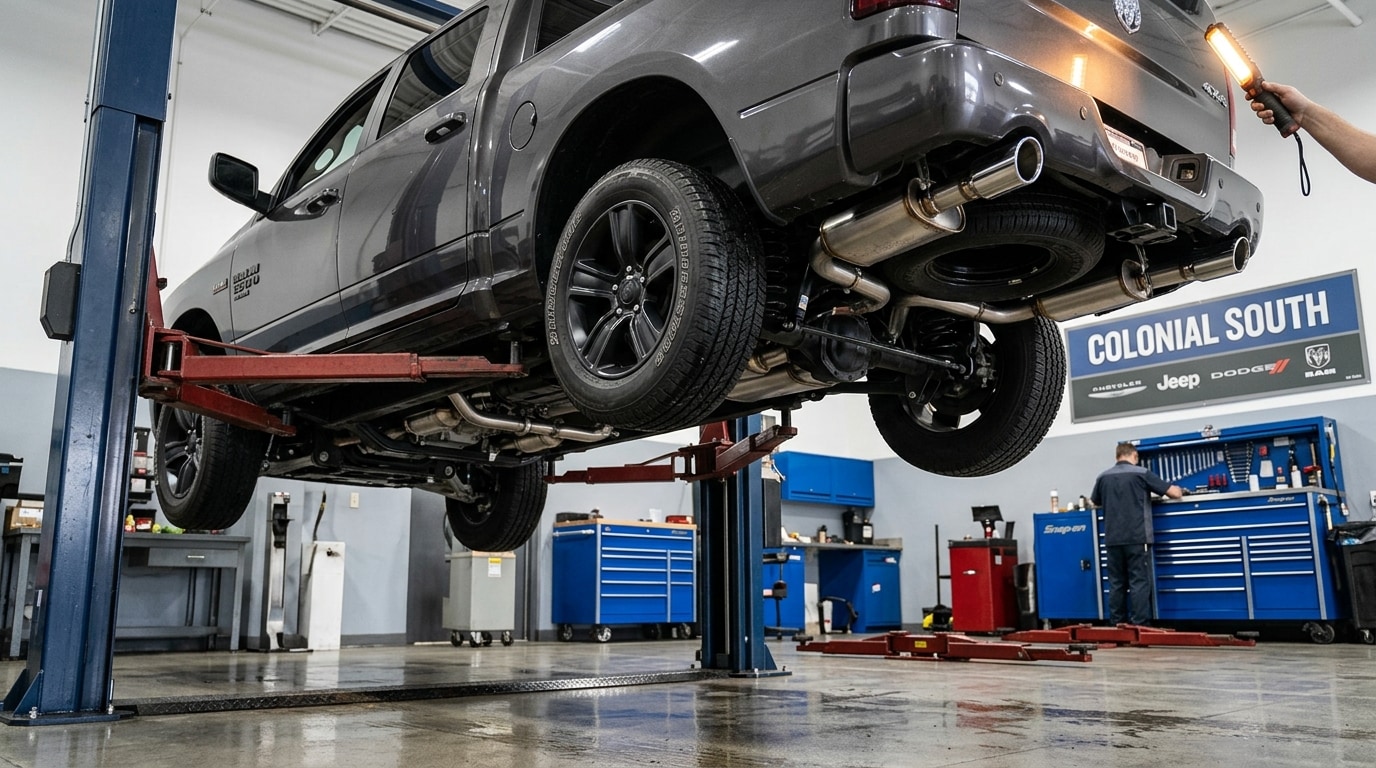
When replacing a damaged or corroded muffler, technicians raise the vehicle on a hydraulic lift, support the exhaust piping, and inspect all rubber mounting hangers and heat shields. On newer Ram trucks equipped with slip-fit band clamps, unbolting the old muffler and mounting a direct-fit replacement is straightforward. On older vehicles where salt exposure has fused pipe joints together, technicians must carefully cut away damaged sections and expand connecting pipe ends to ensure a gas-tight seal.
The service timeline for a professional muffler replacement includes:
- Inspecting the catalytic converter, resonator, mid-pipe, and mounting isolators for wear
- Applying penetrating fluid or heat to loosen rusted flange bolts and band clamps
- Removing the degraded muffler shell while protecting nearby heat shielding and spare tire heat guards
- Aligning the new muffler, securing rubber hangers, and torquing clamps to factory specifications
- Running the engine on the lift to verify zero exhaust leaks and proper tailpipe alignment
Using direct-fit Mopar mufflers speeds up repair times and guarantees correct backpressure levels and tailpipe positioning. Truck owners looking to restore factory quietness or source heavy-duty mounting hardware can start by ordering genuine Mopar exhaust parts directly through our specialized department.
Where Can You Get Ram Exhaust System and Muffler Repairs Near Dartmouth and Fall River?
You can get authorized Ram exhaust system and muffler repairs at Colonial South Chrysler Ram Jeep and Dodge, located conveniently on State Road in Dartmouth, serving truck owners across the South Coast region. Certified technicians handle everything from leak diagnostics and manifold stud extractions to catalytic converter repairs and muffler replacements using genuine OEM components.
Heavy-duty commercial trucks and daily-driven pickups alike face demanding driving conditions in New England. Drivers hauling equipment across the Braga Bridge in Fall River subject their exhaust hardware to steep engine loads and harsh coastal weather that accelerate component fatigue. Local truck owners benefit from a dedicated dealership service center equipped with heavy-duty lifts, factory diagnostic scan tools, and direct access to authentic Mopar exhaust components engineered specifically for Ram 1500, 2500, and commercial van platforms.
Our service department provides complete exhaust repair support, including:
- Full OBD-II emissions diagnostic scans and oxygen sensor testing
- Exhaust manifold stud removal and surface-flatness machining
- Catalytic converter and diesel aftertreatment system maintenance
- Factory muffler, resonator, and dual-tailpipe replacement
- Comprehensive heat shield and rubber hanger inspections
To resolve exhaust leaks or schedule a vehicle check-up, stop by our service desk at 42 State Rd, Dartmouth, MA 02747. You can get custom driving routes by mapping your trip to our dealership or reach our service team by calling (508) 984-1900 to reserve your diagnostic appointment.
Common Questions About Ram Exhaust and Muffler Service
Q: How does a damaged catalytic converter affect a Ram truck's performance?
A damaged or clogged catalytic converter creates excessive exhaust backpressure, which restricts engine breathing and severely reduces horsepower, acceleration, and fuel economy. Internal ceramic substrate breakdown can clog the exhaust flow entirely, causing the engine to stall under load or overheat. Additionally, a failed converter allows raw pollutants into the exhaust stream, triggering check engine light codes and causing the vehicle to fail state emissions inspections.
Q: What causes the exhaust heat shield to rattle on a Ram 1500?
Exhaust heat shield rattles occur when thin aluminum shield metal corrodes around its mounting rivets or steel band clamps, causing the shield to loosen and vibrate directly against the exhaust pipe or muffler shell. High thermal expansion cycles and winter road salt accelerate rust around these mounting points. Technicians resolve heat shield noise by replacing corroded straps or installing high-temperature isolation fasteners to secure the barrier without restricting pipe movement.
Q: Can a small exhaust leak damage my truck's engine over time?
Yes, a small exhaust leak near the cylinder head or exhaust manifold can draw cold ambient air into the exhaust stream through pressure pulses, burning sensitive exhaust valves and causing inaccurate oxygen sensor readings. The false lean signals prompt the engine control computer to dump excess fuel into the cylinders, which fouls spark plugs, dilutes engine oil, and causes premature catalytic converter failure over prolonged driving.
Q: Is exhaust system wear covered under the Ram factory warranty?
Defects in factory exhaust materials or workmanship are covered under the bumper-to-bumper warranty for initial time and mileage limits, while major emissions components like catalytic converters and engine control modules receive long-term coverage under federal emissions warranties. However, wear caused by road salt corrosion, physical impact damage from off-roading, or aftermarket modifications is generally excluded from standard warranty coverage.
Q: How often should the exhaust system hangers and isolators be inspected?
Exhaust rubber hangers and mounting isolators should be inspected during every oil change or 10,000-mile maintenance check. Over time, heat exposure, road salt, and engine vibration cause rubber isolators to stretch, crack, or dry-rot. Worn hangers allow heavy mufflers and tailpipes to sag, placing immense structural strain on exhaust manifold joints and catalytic converter flanges.
Keep Your Ram Truck Running Quiet and Efficiently
Maintaining a healthy exhaust system is essential for preserving your Ram truck's towing capability, cabin comfort, and fuel efficiency. Addressing small leaks, loose heat shields, or cold-start ticking noises early protects critical engine components and prevents costly repairs down the road.
Whether you need a quick inspection, a replacement Mopar muffler, or complete manifold bolt extractions, our factory-trained service technicians at Colonial South Chrysler Ram Jeep and Dodge are ready to help. Schedule your next service visit online or visit our Dartmouth service center to ensure your truck delivers optimal performance on every job.
© 2026 Colonial South Chrysler Ram Jeep and Dodge. All rights reserved.